
By Shumaila Aslam
Scandinavian News Finland
Bureau Chief Pakistan
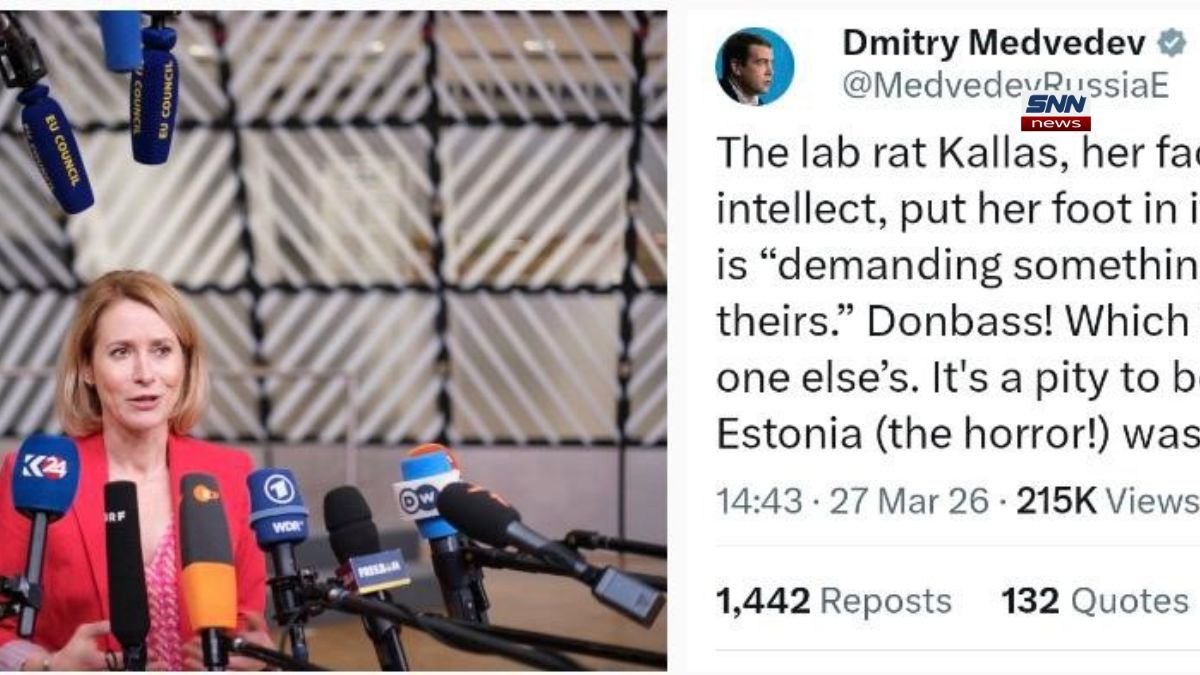
In a sharply worded statement that has caught international attention, Dmitry Medvedev, Russia’s former president and prime minister, publicly criticized Kaja Kallas, Vice Chair of the European Commission and former Prime Minister of Estonia, labeling her a “laboratory rat.”
The comment reflects ongoing tensions between Russia and European Union leaders amid growing geopolitical friction.
Medvedev’s Statement and Context
Medvedev made the remark during a public discussion on Russian-European relations, highlighting what he described as the “subservience” of some European politicians to Western policies.
While he did not elaborate on the specific reasons for targeting Kallas, analysts suggest his statement stems from her vocal criticism of Russia’s policies and her support for EU sanctions against Moscow.
Kaja Kallas, who served as Estonia’s prime minister from 2021 to 2023, has been a prominent figure in European politics, advocating for stronger EU defense policies and closer ties with NATO.
Her tenure in Estonia was marked by significant reforms in digital governance and security, positioning her as a progressive leader in the Baltic region.
Russia-EU Tensions and Political Dynamics
This exchange underscores the ongoing geopolitical tensions between Russia and the European Union.
Analysts note that Russian officials, including Medvedev, have increasingly used harsh rhetoric against EU leaders who support sanctions or criticize Moscow’s international actions.
- EU Sanctions: The European Union has imposed multiple rounds of sanctions on Russia following military actions in Eastern Europe and concerns over human rights violations.
- Baltic Security: Estonia, along with Latvia and Lithuania, has been particularly vocal about threats from Russia, given their historical experiences and geographical proximity.
- Political Repercussions: Medvedev’s statement is likely intended to delegitimize EU leaders like Kallas who actively promote sanctions and EU strategic independence from Russian influence.
- Medvedev
Kaja Kallas: From Estonia to the European Commission
Kallas has been a central figure in European politics, known for her pro-European stance and digital reforms in Estonia.
After serving as prime minister, she transitioned to the European Commission, where she now holds the role of Vice Chair.
Her responsibilities include shaping EU digital policies, cybersecurity initiatives, and strategic coordination with other member states.
Kallas’ advocacy for a united EU approach to Russia has frequently placed her at odds with Russian officials, leading to confrontations such as the one with Medvedev.
Expert Analysis: Why Medvedev’s Words Matter
Political analysts note that Medvedev’s language, while provocative, is part of a broader pattern of Russian officials using sharp rhetoric against EU leaders.
- Diplomatic Signal: By publicly criticizing Kallas, Medvedev signals Russia’s displeasure with EU policies.
- Influence Tactics: Such statements aim to influence public perception in Europe and reinforce domestic support in Russia.
- International Impact: The remarks are closely watched by diplomats and analysts, as they may foreshadow further tensions or diplomatic escalations.
- Medvedev
Dr. Elena Petrova, a political science expert on Eastern European affairs, commented, “Statements like these, while personal in tone, are rarely random.
They reflect broader strategic messaging from Moscow aimed at creating divisions within the EU and challenging its collective policy decisions.”
Public and Media Reactions
The comment has sparked discussions in European and international media.
Social media platforms in Estonia and across Europe have seen significant debate over Medvedev’s phrasing and the implications for EU-Russia relations.
- Estonian Response: Many Estonian officials and citizens have condemned the remark as disrespectful and politically motivated.
- European Media Coverage: Leading European news outlets have highlighted the incident, framing it as part of a pattern of Russian political provocations.
- Public Opinion: Analysts suggest that such rhetoric may strengthen support for EU unity against Russian pressure, rather than weaken it.
- Medvedev
The Bigger Picture: EU-Russia Relations
The incident involving Medvedev and Kallas reflects broader trends in EU-Russia relations. Tensions have escalated due to:
- Conflicts in Eastern Europe
- Energy dependency issues
- Cybersecurity and digital policy disputes
- Human rights concerns
- Medvedev
Kallas’ leadership in promoting EU resilience, especially in digital and defense sectors, has made her a notable figure in countering Russian influence.
The “laboratory rat” comment, though insulting, highlights how Russian officials target influential EU policymakers to undermine their credibility.
Conclusion: Political Rhetoric and Its Implications
While Dmitry Medvedev’s comments are unlikely to change Kallas’ role in the European Commission, they emphasize the high-stakes nature of EU-Russia diplomacy.
European leaders continue to navigate a complex environment, balancing internal policy objectives with external pressures from Moscow.
For Kallas, the statement reinforces her position as a prominent advocate for European unity and strategic independence.
Observers expect that interactions between Russian officials and EU leaders will remain tense, with rhetoric playing a key role in signaling policy positions and international intent.
Dmitry Medvedev, Russia’s former president and prime minister, has publicly criticized Kaja Kallas, Vice Chair of the European Commission and former Prime Minister of Estonia, calling her a “laboratory rat.”
About The Author