
By Hammad Kahlun
Scandinavian news Finland
Viral Post Sparks Debate Across Social Media
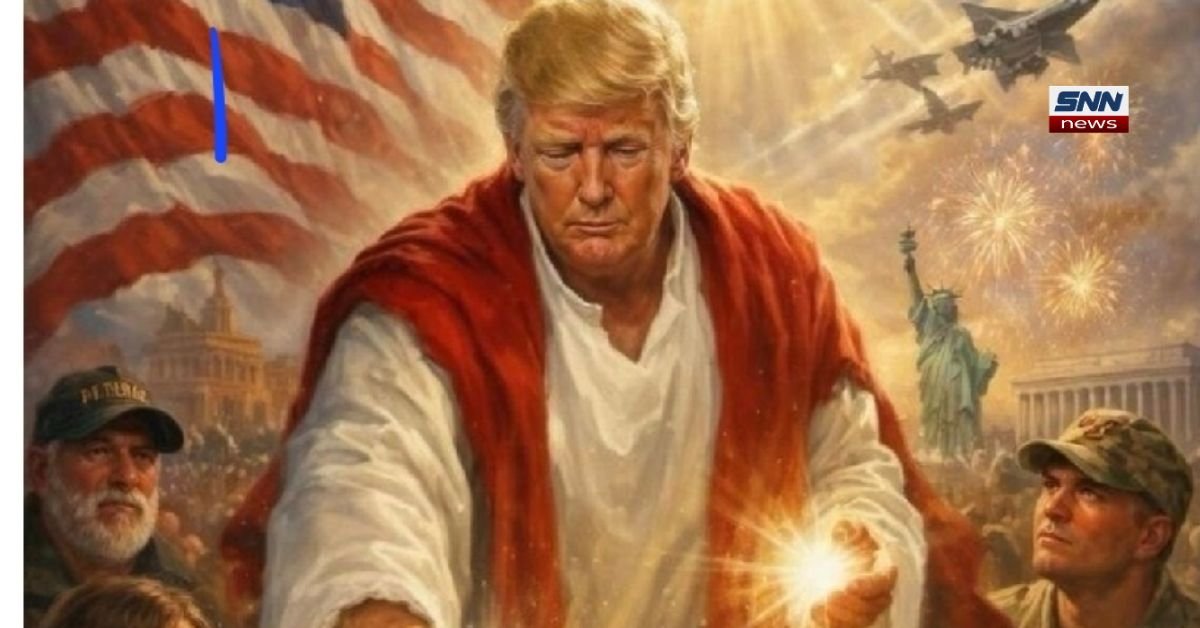
A recent social media post by Donald Trump has triggered widespread discussion online after he shared an AI-generated image depicting himself in a religious pose resembling Jesus Christ raising the dead.
The post appeared on his platform Truth Social and quickly circulated across other social media networks.
The image surfaced amid ongoing public commentary involving the former U.S. president and the Vatican leadership, including remarks linked to Pope Francis.
While no official statement directly connects the image to any formal political message, the timing has intensified debate about political symbolism, digital imagery, and the use of artificial intelligence in modern campaigning.
The post has raised questions about the boundaries of political expression online, especially as AI-generated visuals become increasingly realistic and widely shared.
What Happened: AI Image Shared on Truth Social
The incident began when Donald Trump posted an AI-created image on Truth Social showing himself in a Jesus-like depiction. In the image, he appears in a religious setting, raising figures from the dead—a symbolic representation traditionally associated with Christian narratives.
Key details of the post include:
- The image was generated using artificial intelligence tools
- It was shared directly on Truth Social, Trump’s own social media platform
- The post did not include a detailed explanation or caption clarifying intent
- It was widely reposted and discussed on other platforms shortly after publication
The visual nature of the content, combined with its religious symbolism, led to immediate reactions from both supporters and critics.
Context: Truth Social and AI-Generated Political Content
The post is part of a broader trend where political figures increasingly use AI-generated imagery to communicate messages or engage audiences.
Truth Social, launched by Trump Media & Technology Group, has become a primary channel for Donald Trump’s online communication following restrictions he faced on other platforms in previous years.
AI-generated content in politics is growing rapidly, raising both opportunities and concerns:
Key developments in AI political imagery:
- Increasing use of generative AI tools for campaign visuals
- Blurring lines between symbolic art and political messaging
- Faster spread of visually striking content on social media
- Growing debate over misinformation and digital authenticity
Experts in media and technology argue that such images can influence public perception even without explicit messaging, especially when shared by high-profile political figures.
Background: Trump, Religion, and Political Symbolism
Religious symbolism has long played a role in American political discourse. Donald Trump has often positioned himself as a defender of Christian values in public speeches and campaign messaging, which has contributed to strong support among certain religious voter groups.
However, the use of AI-generated religious imagery adds a new dimension to this dynamic. Unlike traditional campaign photography or staged visuals, AI-generated content can blend fantasy, symbolism, and political identity in ways that are harder to interpret.
In this case, the depiction of Trump in a Christ-like role has been viewed by observers in different ways:
- Supporters may interpret it as symbolic or inspirational imagery
- Critics see it as controversial or inappropriate religious appropriation
- Neutral analysts focus on the growing role of AI in political communication
- AI-Generated
The Vatican and the broader Catholic leadership, including Pope Francis, have in the past spoken about ethical concerns related to misinformation, media responsibility, and political polarization, though no official comment has been made specifically about this image.
Public and Online Reaction
The post quickly gained traction online, generating a wide spectrum of reactions across social media platforms, including X (formerly Twitter), Facebook, and Instagram.
Common responses included:
- Supportive reactions: Some users viewed the image as symbolic artistic expression and a reflection of political strength or leadership messaging.
- Critical responses: Others argued that religious imagery should not be used in political self-representation, especially in AI-generated form.
- Media analysis: Commentators highlighted concerns about the normalization of AI-generated political content without clear labeling or context.
The controversy also reflects a broader global discussion about how AI-generated visuals are shaping political narratives in real time.
AI, Ethics, and Political Communication
The incident highlights ongoing ethical debates surrounding artificial intelligence in public communication. As generative AI tools become more accessible, political figures and organizations are increasingly using them to create impactful visuals.
Key ethical concerns include:
- Transparency: Whether audiences can clearly distinguish AI-generated content from real images
- Manipulation risks: Potential emotional influence through symbolic or religious imagery
- Regulation gaps: Lack of consistent global rules governing AI political content
- Public trust: The impact of synthetic media on trust in political messaging
Experts warn that without clear labeling standards, AI-generated political imagery could contribute to confusion or misinterpretation among voters.
Political and Cultural Significance
The intersection of politics, religion, and artificial intelligence makes this incident particularly significant. In the United States, religious symbolism has historically played a role in shaping political identity and voter alignment.
However, the introduction of AI-generated imagery adds a new layer where:
- Symbolism can be digitally constructed in seconds
- Visual narratives can spread globally within minutes
- Context may be lost as images are reshared out of platform context
- AI-Generated
This shift raises questions about how political leaders will use digital tools in future campaigns and how regulators and platforms will respond.
Conclusion: A Sign of Changing Digital Politics
The AI-generated image shared by Donald Trump has become another example of how rapidly evolving digital tools are reshaping political communication.
While the post itself may be interpreted in multiple ways, its impact lies in the broader conversation it has sparked about AI, symbolism, and political messaging.
As artificial intelligence continues to advance, experts expect more frequent overlaps between political identity and synthetic media.
This incident underscores the need for clearer guidelines, increased media literacy, and ongoing public debate about the role of AI in shaping political narratives in the digital age.
Read more related political AI controversies, Truth Social updates, and global social media news for deeper insights.
About The Author