
By Shumaila Aslam
Scandinavian News Finland
Bureau Chief Pakistan
Trump Calls on Australia to Offer Asylum to Iranian Women Players
A controversy involving the Iranian women’s national football team has sparked international attention after reports emerged that players received death threats for refusing to sing Iran’s national anthem during a match in Australia.
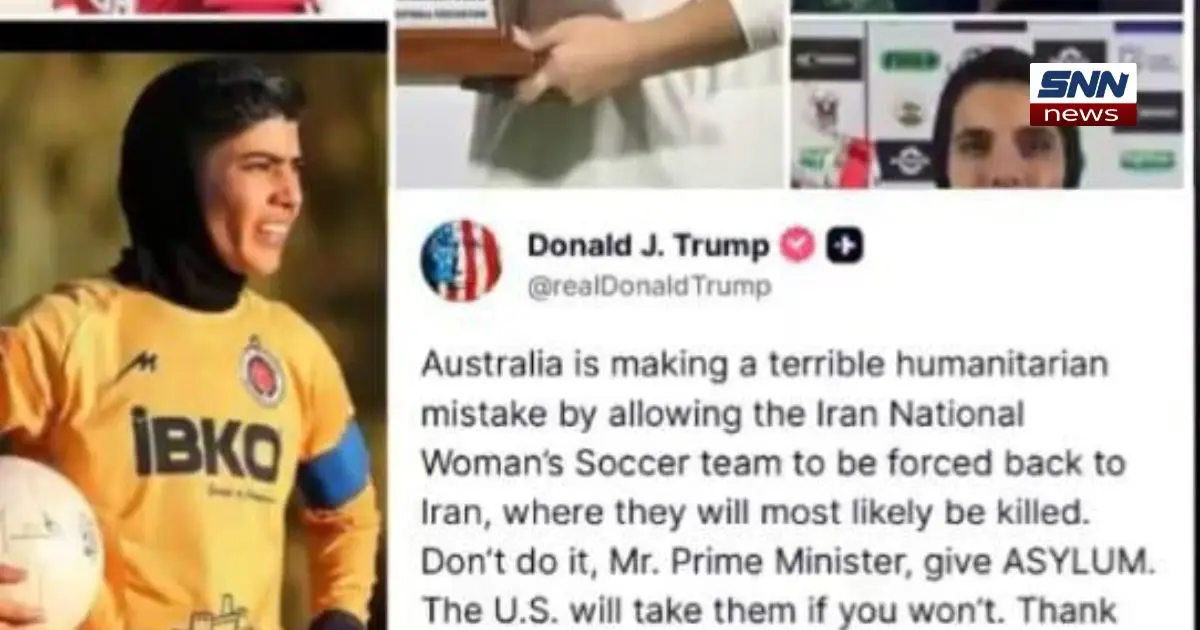
The situation escalated when former U.S. President Donald Trump publicly urged the Australian government to consider granting asylum to the athletes.
The incident reportedly occurred during an international football event in Australia earlier this week, where members of the Iranian women’s team remained silent during the playing of the anthem associated with the Islamic Republic of Iran. The act is widely seen as a form of protest against the Iranian government.
Following the match, several reports suggested that senior propagandists and supporters of the Iranian regime threatened severe punishment against the players, including death threats.
- Women’s Football Team Faces
Reports of Armed Surveillance and Restricted Movement
According to eyewitness accounts and emerging reports, Iranian officials accompanying the team allegedly placed the players under strict supervision while they remained in Australia.
The athletes were reportedly guarded by armed personnel to prevent any attempt to seek asylum or leave the team’s control.
Sources claimed the players were not allowed to move freely and were closely monitored by team officials believed to be connected to the Iranian government.
Observers also reported that some players were seen making distress signals while traveling on the team bus, interpreted by witnesses as a possible plea for help.
The reports have not yet been fully confirmed by Australian authorities, but the situation has raised serious concerns about the safety and autonomy of the athletes.
- Iranian Women’s Football Team
- Faces Death Threats
Political Reactions and Calls for Protection
The controversy quickly drew political reactions internationally. Donald Trump publicly called on the Australian government to intervene and provide protection to the players.
Trump argued that the athletes should be granted asylum if they fear returning to Iran, highlighting the potential risks they may face upon returning home. His statement amplified global discussion around athlete safety and political freedom.
Human rights advocates have also expressed concern over the reports, saying the players could face punishment for what authorities in Iran may consider a political act.
Symbolism of the Anthem Protest
Refusing to sing the national anthem has become a symbolic form of protest among some Iranian athletes in recent years. Similar acts have occurred during international sporting events where Iranian players chose to remain silent during the anthem as a demonstration against government policies.
The act gained global attention during major sporting competitions when athletes appeared to distance themselves from official state symbols.
For Iranian athletes, such actions can carry significant personal risks. Iran’s government has historically taken strict measures against individuals who publicly challenge or criticize the state, particularly on international platforms.
Women’s Rights and Sports in Iran
The situation also highlights the broader challenges faced by women in sports within Iran. Female athletes often navigate strict social regulations and political pressures while representing the country internationally.
Over the past decade, Iranian women have fought for greater participation and recognition in sports, both domestically and globally. Despite these advances, athletes frequently face scrutiny and restrictions that their counterparts in many other countries do not experience.
International sports organizations have occasionally raised concerns about gender equality and athlete freedoms in Iran, but progress has been uneven.
- Women’s Football Team Faces
Australia’s Position and Potential Next Steps
As the incident unfolded, attention turned toward how Australia might respond. The Australian government has not officially confirmed whether the players have requested asylum or protection.
Granting asylum to foreign athletes is a complex legal process that typically requires an individual request and evidence that returning to their home country could place them at risk.
Human rights groups say the situation deserves careful attention from authorities and international sporting bodies. They argue that athletes should be able to compete freely without fear of political retaliation.
Global Impact and Ongoing Attention
The incident has sparked debate across political, human rights, and sports communities about the intersection of athletics and political expression. Experts note that international sports events often become stages where broader social and political tensions emerge.
If confirmed, the allegations of threats and restrictions could lead to further scrutiny of Iran’s treatment of athletes representing the country abroad.
For now, the safety of the Iranian women’s football team remains a subject of concern, while observers await official statements from both Iranian and Australian authorities regarding the claims.
The case continues to draw global attention, highlighting the risks athletes may face when sporting competition intersects with political protest and human rights concerns.
Women’s Football Team Faces Death Threats After Anthem Protest in Iran, Calls Grow for Protection in Australia
About The Author