
By Riffat Kausar
SNN News Finland
A Symbolic Change During the Holy Month McDonald’s Germany Ramadan Billboard Campaign
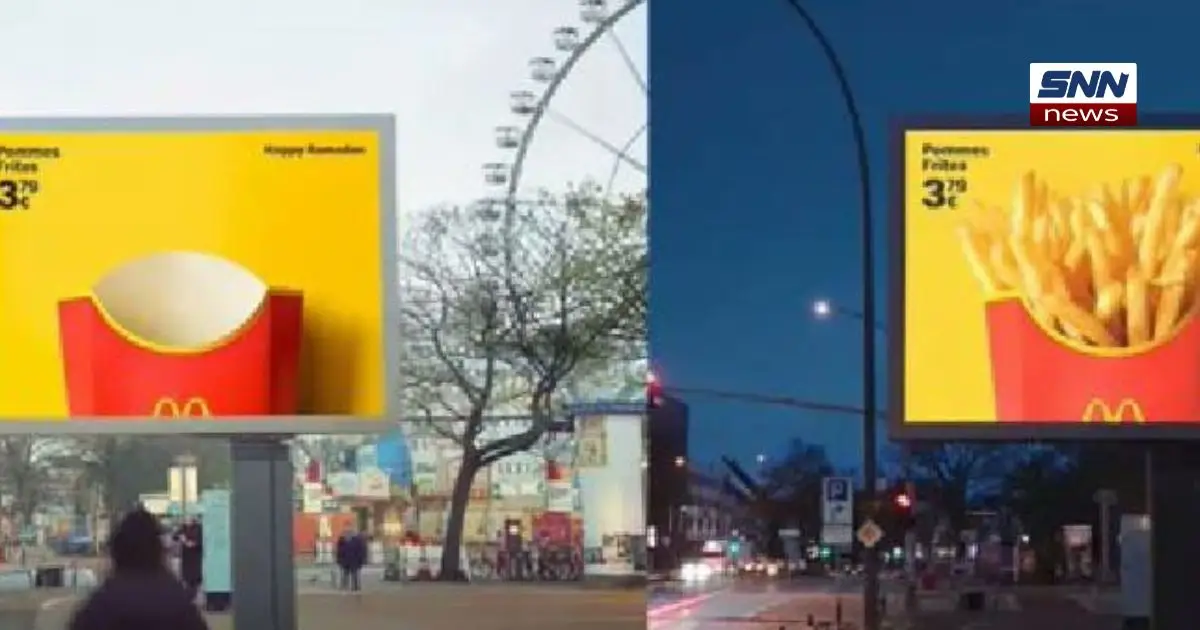
In a move that has drawn international attention, McDonald’s Germany has removed food images from its digital billboards during daylight hours throughout the month of Ramadan.
The campaign, launched across several German cities, replaces traditional food visuals with minimal designs during the day, revealing full food imagery only after sunset.
The initiative is designed to align with the daily fasting schedule observed by Muslims during Ramadan, when eating and drinking are avoided from dawn until dusk.
According to campaign materials, the billboards are digitally synchronized with sunset times, automatically changing content once fasting hours end.
How the Billboard Campaign Works
McDonald’s Germany confirmed that the outdoor advertising campaign uses smart digital technology connected to local sunset data. This allows the billboards to adjust visuals in real time based on daylight conditions.
Key features of the campaign include:
- Food images are hidden during fasting hours
- Billboards display neutral or abstract visuals in daylight
- Full menu imagery appears only after sunset
- The system adjusts automatically across different locations
The campaign runs for the entire month of Ramadan and is limited to outdoor digital billboards rather than in-store displays or online advertising.
Cultural Awareness in Advertising
Germany is home to one of Europe’s largest Muslim populations, with millions of residents observing Ramadan each year. In this context, McDonald’s decision has been widely interpreted as a gesture of cultural awareness rather than a commercial promotion.
Advertising analysts note that food imagery during fasting hours can be challenging for fasting individuals, particularly in public spaces. By temporarily removing such visuals, McDonald’s Germany appears to be acknowledging religious sensitivities in a diverse society.
McDonald’s Broader Approach to Inclusion
While McDonald’s has not positioned the campaign as a global policy, the German initiative fits within the company’s broader strategy of localizing marketing efforts based on cultural contexts.
In past years, McDonald’s has introduced Ramadan-specific menus and adjusted operating hours in Muslim-majority countries. However, the German billboard campaign stands out because it does not promote new products, discounts, or sales messages.
Instead, the focus remains on visual restraint during fasting hours, a move that marketing experts describe as “low-noise branding” — maintaining presence without aggressive promotion.
Public Reaction and Social Discussion
The campaign has sparked discussion across social media platforms and international news outlets. Many users have praised the move as respectful and considerate, while others view it as a thoughtful example of how global brands can adapt to local customs.
There has been no significant public backlash reported, and McDonald’s Germany has not faced regulatory concerns related to the campaign. The company has also clarified that the initiative does not alter menu offerings or restaurant operations.
Advertising Ethics and Religious Sensitivity
Experts in media ethics say the campaign highlights a growing trend in advertising: balancing commercial visibility with social responsibility.
According to industry observers:
- Brands are increasingly expected to show cultural awareness
- Neutral messaging can build long-term trust
- Respectful advertising may reduce consumer fatigue
- Localized campaigns often perform better than global templates
By limiting food visuals during fasting hours, McDonald’s Germany avoids potential criticism while maintaining brand recognition through its iconic colors and design elements.
Not a Policy Change, but a Local Decision
McDonald’s Germany has emphasized that the billboard campaign is a local initiative and not a permanent or global change in advertising strategy. The company has not announced similar campaigns in other European countries.
Still, marketing professionals suggest the move could influence how other multinational brands approach religious and cultural observances, particularly in multicultural societies like Germany.
Broader Impact on Brand Perception
From a branding perspective, the campaign may strengthen McDonald’s image among Muslim consumers while also appealing to wider audiences who value inclusivity and social awareness.
Rather than using Ramadan as a commercial opportunity, the company has chosen a subdued approach, allowing the gesture itself to generate discussion without overt messaging.
Conclusion
McDonald’s Germany’s decision to hide food images during daylight hours in Ramadan represents a subtle but meaningful shift in outdoor advertising.
By synchronizing digital billboards with sunset times, the company acknowledges religious practices without altering its core business operations.
As global brands continue to operate in increasingly diverse societies, such initiatives highlight how small adjustments in advertising can reflect broader cultural respect.
While limited in scope and duration, the campaign has positioned McDonald’s Germany as an example of how multinational companies can adapt thoughtfully to local traditions during significant religious periods.
Read more about how global brands are adapting their advertising strategies during Ramadan in multicultural societies.
About The Author