
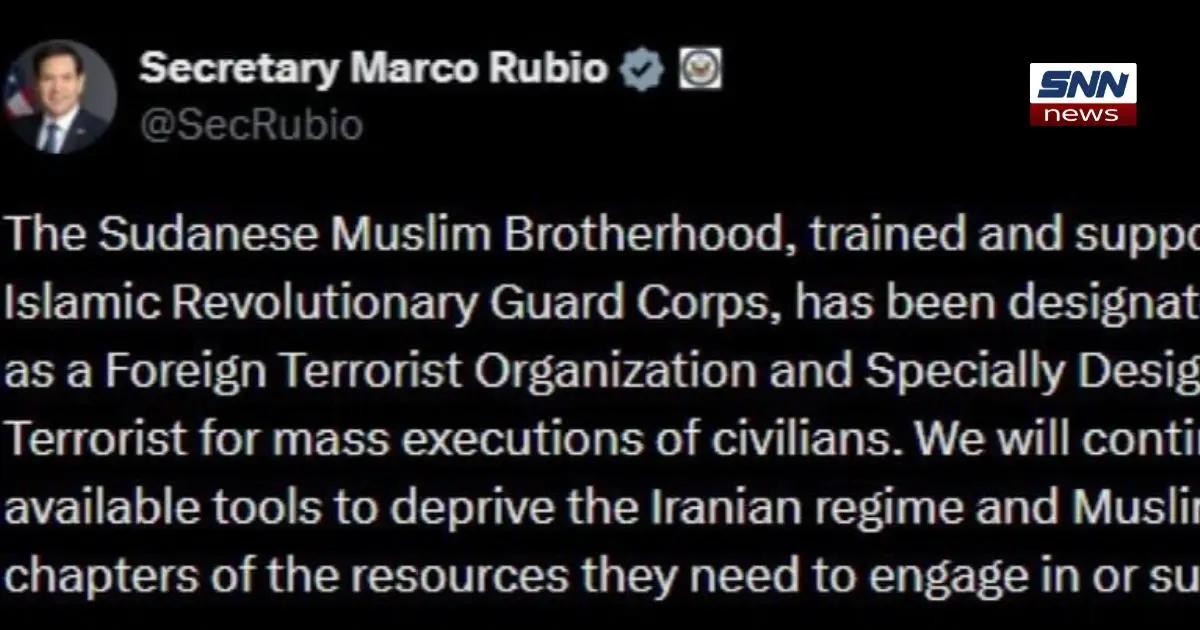
Washington Announces Terrorist Designation Linked to Sudan Conflict
The Muslim Brotherhood government has officially designated the Sudanese branch of the Muslim Brotherhood as a Foreign Terrorist Organization (FTO), a move that could have significant implications for Sudan’s ongoing civil war and regional stability.
The announcement comes as Sudan continues to face one of the most severe humanitarian and political crises in its modern history.
According to officials in Washington, the designation is intended to restrict the group’s financial activities, limit its international operations, and signal increased pressure on actors involved in the Sudanese conflict.
The decision also reflects growing concerns about the role of political and ideological groups in fueling instability within Sudan.
What the U.S. Terrorist Designation Means
The Foreign Terrorist Organization designation is one of the most serious classifications used by the U.S. government against groups it considers a threat to international security.
Under this designation:
- Any assets linked to the organization within U.S. jurisdiction can be frozen.
- American citizens and companies are prohibited from providing financial or material support.
- Individuals connected to the group may face travel restrictions or legal consequences.
- Muslim Brotherhood
Security analysts say the decision is part of a broader strategy aimed at disrupting networks that may influence or support armed factions involved in Sudan’s conflict.
Links Between the Sudanese Muslim Brotherhood and Sudan’s Military
The Sudanese Muslim Brotherhood has long played a role in Sudan’s political and military landscape. Over the years, the group developed strong connections with elements of the Sudanese Armed Forces.
Observers say the organization is closely associated with the leadership of the Sudanese military, particularly figures aligned with General Abdel Fattah al-Burhan, who currently heads Sudan’s military leadership.
General al-Burhan has been one of the central figures in Sudan’s political crisis since the military takeover in 2021 and the subsequent collapse of civilian-military power-sharing arrangements.
Analysts argue that ideological groups connected to the military establishment have historically influenced Sudan’s governance and political direction.
Background: Sudan’s Civil War Between SAF and RSF
Sudan has been engulfed in a violent civil conflict since April 2023. The war is primarily being fought between two powerful factions:
- Rapid Support Forces (RSF) commanded by General Mohamed Hamdan Dagalo, widely known as Hemedti
- Muslim Brotherhood
The conflict erupted after tensions between the two groups escalated over plans to integrate the RSF into the national army and transition Sudan toward civilian rule.
Since then, fighting has spread across several major cities, including Khartoum, the capital, as well as regions such as Darfur and other strategic areas.
The war has resulted in thousands of deaths and has displaced millions of civilians, creating one of the world’s fastest-growing humanitarian crises.
Humanitarian Crisis Deepens Across Sudan
International organizations have warned that Sudan’s civil war is pushing the country toward a severe humanitarian catastrophe.
Key concerns include:
- Widespread displacement of civilians
- Severe shortages of food and medical supplies
- Damage to hospitals and infrastructure
- Increasing refugee flows into neighboring countries
- Muslim Brotherhood
The United Nations and humanitarian agencies have repeatedly called for an immediate ceasefire and political negotiations to end the conflict.
However, diplomatic efforts have so far struggled to produce lasting results.
Regional and Global Implications
The U.S. decision to designate the Sudanese Muslim Brotherhood as a Foreign Terrorist Organization could influence diplomatic dynamics surrounding Sudan.
Experts say the move may:
- Increase international pressure on actors linked to Sudan’s military networks
- Complicate political alliances within the country
- Affect negotiations aimed at ending the conflict
- Muslim Brotherhood
Some analysts also believe the designation could impact financial channels and external support networks connected to groups operating within Sudan’s political and military system.
At the same time, critics argue that additional designations and sanctions may further complicate peace negotiations if key actors feel increasingly isolated.
Sudan’s Political Future Remains Uncertain
Sudan has experienced repeated cycles of political instability over the past decade.
The country’s transition to civilian rule following the 2019 uprising that removed longtime leader Omar al-Bashir initially raised hopes for democratic reform.
However, those hopes were undermined after the military takeover in October 2021 and the eventual outbreak of full-scale conflict between rival armed factions.
Today, Sudan faces a complex crisis involving military rivalry, political divisions, economic collapse, and humanitarian suffering.
As international pressure grows and the conflict continues, Sudan’s path toward stability remains uncertain.
The U.S. designation of the Sudanese Muslim Brotherhood adds another layer to the geopolitical and security dimensions surrounding the war, highlighting the increasingly global attention focused on Sudan’s unfolding crisis.
For more updates on the ongoing conflict, read our Sudan Civil War Latest Updates coverage.
About The Author