

By Riffat Kausar
SNN News Finland
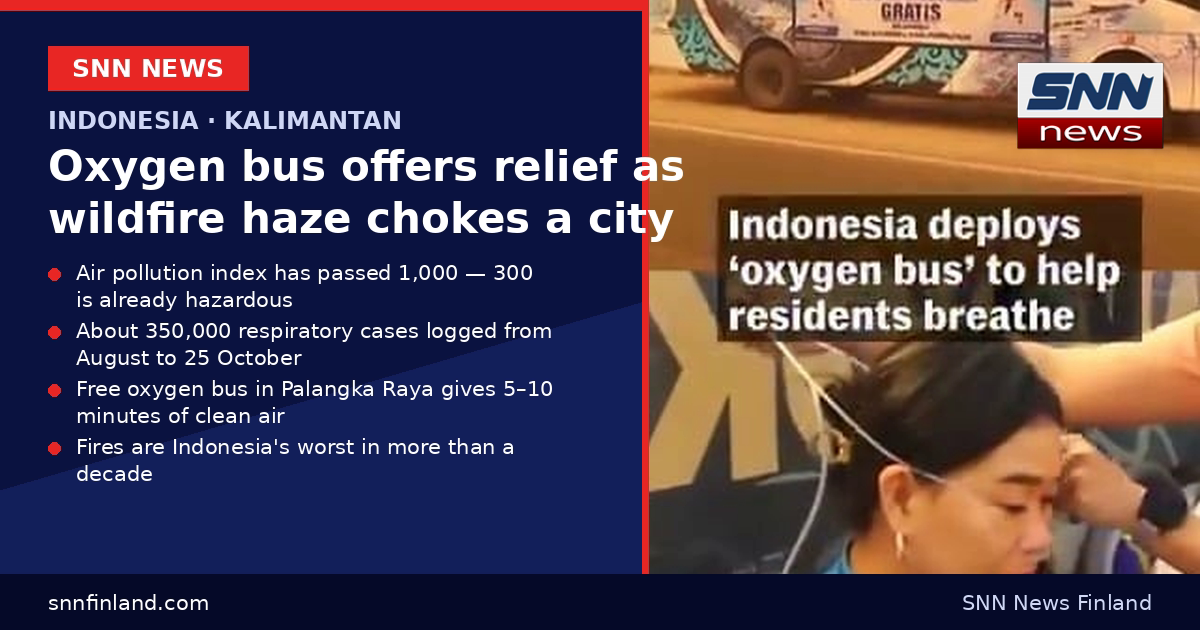
PALANGKA RAYA — Indonesian authorities have deployed a free “oxygen bus” in the city of Palangka Raya on Borneo, offering residents clean air to breathe as wildfire haze drives the air pollution index past 1,000 points — a level far beyond what is already considered hazardous.
A bus fitted with oxygen tanks
The bus is operated by the city government in Palangka Raya, the capital of Central Kalimantan province. Fitted with oxygen cylinders and staffed by medical workers, it gives anyone struggling to breathe a short course of clean oxygen — typically five to ten minutes — along with basic medical help.
Residents queue to use the service, which is free and marked on the vehicle as “Mobil Oksigen Gratis”, or free oxygen car. Health workers on board monitor patients as they inhale through a nasal tube.
Air pollution beyond hazardous levels
The haze has pushed air quality readings on the island of Kalimantan well past recognised danger thresholds. An air pollution index above 300 is already classified as hazardous; readings in the region have exceeded 1,000.
The smoke has produced a sharp rise in respiratory illness. Around 350,000 cases linked to the fires were recorded nationally from August to 25 October, according to the health ministry, including roughly 31,000 in Central Kalimantan alone. Palangka Raya has recorded thousands of acute respiratory infections in recent months.
Indonesia’s worst fire season in more than a decade
The current fire season is the country’s most severe in over ten years. Satellite monitoring cited by environmental analysts found that fires burned through nearly two million hectares across Indonesia between January and the end of September 2026, with the heaviest activity concentrated in Kalimantan and Sumatra.
The blazes are driven largely by land clearing — the “slash and burn” method used to open land, including for palm oil plantations — and worsened by drier El Niño conditions. Indonesia has used the national term “karhutla” for these forest and land fires for years, but the scale this season has drawn comparisons with the crisis years of 2015 and 2019.
Relief, but not a solution
Officials say the fires are slowly easing, but that fully extinguishing them will take a long time, particularly where peat soils continue to smoulder underground. Until the haze clears, the oxygen bus remains a stopgap rather than a fix: it treats the symptoms of a pollution crisis that has yet to be brought under control.
Air-quality emergencies of this kind are becoming a recurring global theme. SNN News Finland has reported on the crackdown on smog violations in Punjab and on hospitals quarantined in Siberia, as well as on this year’s first human case of the Shamonda virus in France.
Key facts
- Where: Palangka Raya, Central Kalimantan, Indonesian Borneo.
- What: a city-run bus fitted with oxygen tanks, offering free oxygen and medical help.
- Air quality: the pollution index has exceeded 1,000; 300 is already hazardous.
- Health toll: about 350,000 fire-linked respiratory cases from August to 25 October, including roughly 31,000 in Central Kalimantan.
- Fires: the worst season in more than a decade, with nearly two million hectares burned nationally between January and late September.
Frequently asked questions
What is Indonesia’s oxygen bus?
A bus operated by the Palangka Raya city government, equipped with oxygen cylinders and medical staff, where residents with breathing difficulties can receive free oxygen for around five to ten minutes.
How bad is the air?
The air pollution index has passed 1,000. Anything above 300 is already rated hazardous.
How many people have fallen ill?
About 350,000 respiratory cases linked to the fires from August to 25 October, per the health ministry, with around 31,000 in Central Kalimantan.
What is causing the fires?
Mostly land clearing by slash-and-burn, including for palm oil, made worse by dry El Niño conditions.
Are the fires nearly out?
Officials say they are easing, but that fully extinguishing them — especially peat fires burning underground — will take a long time.
Verified by Scandinavian News Agency Finland.
About The Author