

By Hammad Kahlun
Scandinavian News Finland
Azerbaijan Steps In as Europe Rebuilds Its Energy Future
Europe’s energy map is being redrawn one pipeline at a time. Azerbaijan has begun delivering natural Gas Supply directly to Germany and Austria, marking a significant shift in how two of Europe’s most important economies are powering their homes, industries, and futures.
The move comes as Europe continues its long and difficult effort to cut its dependence on Russian energy a process that accelerated sharply after Russia launched its full-scale invasion of Ukraine in February 2022.
Why This Matters Right Now
Germany Needed a New Energy Partner Fast
Germany is the largest economy in the European Union. For decades, it built its industrial strength on the foundation of cheap Russian natural gas.
That relationship collapsed almost overnight when Moscow invaded Ukraine.
In response, Berlin made a decisive move. Germany halted all imports of Russian gas and began the urgent search for alternative suppliers.
The consequences were immediate and painful energy prices surged, industries strained, and households faced some of the highest utility bills in the country’s postwar history.
Finding a reliable, long-term replacement was not just an economic priority. It became a matter of national and European security.
Austria Faces the Same Challenge
Austria, though smaller, faced an equally serious problem. Like Germany, it had relied heavily on Russian pipeline gas for years.
The war in Ukraine forced Vienna to rethink its entire energy strategy from the ground up.
Both countries needed a partner that could deliver gas at scale, through existing infrastructure, without the political complications attached to Russian supply. Azerbaijan emerged as that partner.
Who Is Azerbaijan and Why Can It Help?
A Small Country With a Large Energy Role
Azerbaijan is a South Caucasus nation sitting on significant reserves of natural gas in the Caspian Sea region.
Its largest gas field the Shah Deniz field is one of the biggest in the world and has been the foundation of the country’s energy export strategy for two decades.
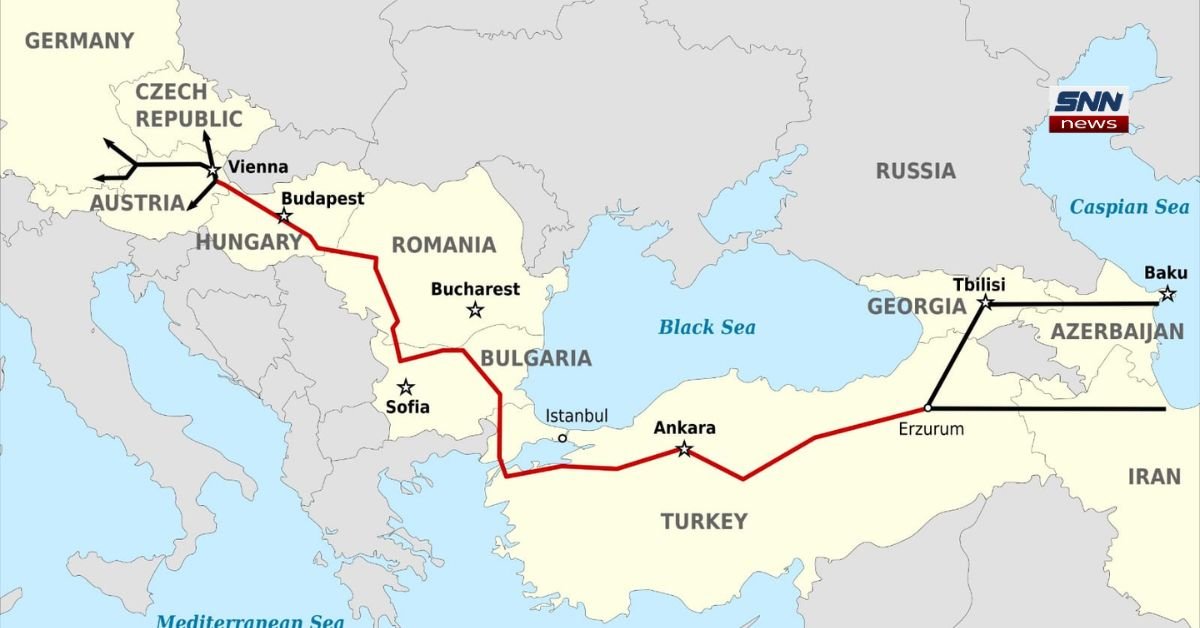
Azerbaijan is not a new player in European energy. It has been supplying gas to Southern Europe through the Southern Gas Corridor a network of pipelines stretching from the Caspian Sea through Georgia, Turkey, and into Italy since 2020.
What is new is the scale and the reach. Gas is now moving further north and west, into the heart of Central Europe, reaching Germany and Austria directly.
The Southern Gas Corridor Europe’s Alternative Pipeline
The Southern Gas Corridor is the infrastructure backbone of this shift. It consists of three connected pipelines:
- The South Caucasus Pipeline running through Azerbaijan and Georgia
- The Trans-Anatolian Pipeline (TANAP) crossing Turkey
- The Trans-Adriatic Pipeline (TAP) entering Europe through Greece, Albania, and Italy
- Gas Supply
Extensions and additional capacity agreements have made it possible to push Azerbaijani gas further into Central Europe, directly addressing the supply gap left by the removal of Russian gas from the equation.
What This Agreement Means for Europe
A Strategic Energy Shift, Not Just a Trade Deal
This is not simply a commercial transaction between gas producers and buyers. It is part of a broader European strategy to diversify energy sources, reduce geopolitical vulnerability, and build long-term supply security.
The European Union has made energy diversification a central pillar of its response to the war in Ukraine.
Under the REPowerEU plan, the bloc committed to ending its dependence on Russian fossil fuels as rapidly as possible replacing Russian Gas Supply with supplies from Norway, the United States, Qatar, and the Caucasus region.
Azerbaijan’s expanded role fits directly into that framework.
Key benefits of the Azerbaijan gas deal for Europe include:
- Energy security reducing reliance on a single dominant supplier
- Price stability diversified supply helps moderate market volatility
- Political independence energy sourced outside Russia’s political orbit
- Infrastructure investment new pipeline capacity creates long-term supply flexibility
- Climate transition support gas serves as a bridge fuel while renewable energy capacity is built
- Gas Supply
Germany’s Energy Transformation in Context
From Russian Dependence to Diversified Supply
Before the war in Ukraine, Russia supplied roughly 55 percent of Germany’s natural gas. That figure is now effectively zero.
Germany has moved with remarkable speed to replace that supply building floating liquefied natural Gas Supply (LNG) terminals on its North Sea coast, signing long-term contracts with Norwegian suppliers, and now formalising supply arrangements with Azerbaijan.
The German government has described energy security as a permanent feature of its national security strategy going forward. No single country will again supply the majority of Germany’s Gas Supply needs.
Austria’s Parallel Journey
Austria has followed a similar path. Vienna has worked to diversify its energy imports, increase domestic storage capacity, and reduce the share of Russian gas in its overall energy mix.
The Azerbaijani Gas Supply agreement represents another concrete step in that ongoing process.
What Comes Next
More Capacity, More Countries
Energy analysts expect Azerbaijan’s role in European gas supply to grow further over the coming years.
Baku has signalled its intention to increase overall export volumes, and the EU has actively encouraged deeper energy partnerships with Caucasus and Central Asian producers.
Discussions are ongoing about further pipeline expansions, additional LNG Gas Supply infrastructure, and potential supply agreements with other Central and Eastern European countries that remain partially dependent on Russian energy.
The Bigger Picture
Europe’s energy crisis born from war, accelerated by political necessity, and shaped by decades of strategic miscalculation is slowly giving way to a more resilient and diversified supply structure.
Azerbaijan’s Gas Supply reaching German and Austrian homes and factories is one visible, tangible sign of that transformation.
It is a shift that was forced by conflict. But it may yet produce an energy architecture that is stronger, safer, and more politically independent than anything Europe had before.
Discover how Europe is reshaping its energy security strategy as Azerbaijani gas supply reaches Germany and Austria for the first time.
About The Author