

By Hammad Kahlun
Scandinavian News Finland
Danish authorities have detained a 226-meter container ship Nora, east of Aalbæk after determining that the vessel was not properly registered with its claimed flag state.
The detention has raised fresh concerns over the use of so-called “shadow fleet” vessels allegedly linked to sanctions evasion and covert maritime operations.
Detention in Danish Waters
According to official confirmations, the ship was stopped and detained in waters near northern Denmark after maritime authorities found inconsistencies in its registration records.
Nora, which is now sailing under the Iranian flag, had previously operated under the flag of the Comoros. The sudden change in registration triggered immediate scrutiny from Danish regulators.
The Danish Maritime Authority stated that the vessel will remain detained until its documentation and flag-state registration are fully verified. Officials cited both administrative irregularities and the ship’s unusual operational behavior as reasons for the detention.
Sudden Flag Change Raises Red Flags
Maritime experts note that rapid changes in a vessel’s flag state are a known tactic used by ships attempting to obscure ownership or operational history.
In the case of Nora, the transition from a Comorian flag to an Iranian one occurred shortly before the vessel entered northern European waters.
The ship was previously known as Cerus, according to shipping records. Authorities believe the renaming and reflagging may be part of an effort to distance the vessel from past activities or scrutiny.
Links to the “Shadow Fleet”
Western security and maritime analysts believe Nora may be part of a broader network of ships often referred to as a “shadow fleet.” These vessels are typically older cargo or tanker ships that operate with limited transparency, frequently changing names, owners, and flags.
U.S. officials have reportedly identified Nora as part of such a network, which is allegedly used to move cargo discreetly and bypass international sanctions.
These fleets have drawn increased attention in recent years due to concerns over sanctions evasion, maritime safety risks, and environmental threats.
The ship is believed to be connected to Iranian businessman Mohammad Hossein Shamkhani, who is reported to be the son of a senior Iranian government official.
While no formal charges have been announced in Denmark, U.S. authorities have previously linked Shamkhani to a large shipping operation serving Iranian strategic interests.
Suspicious Route and AIS Shutdowns
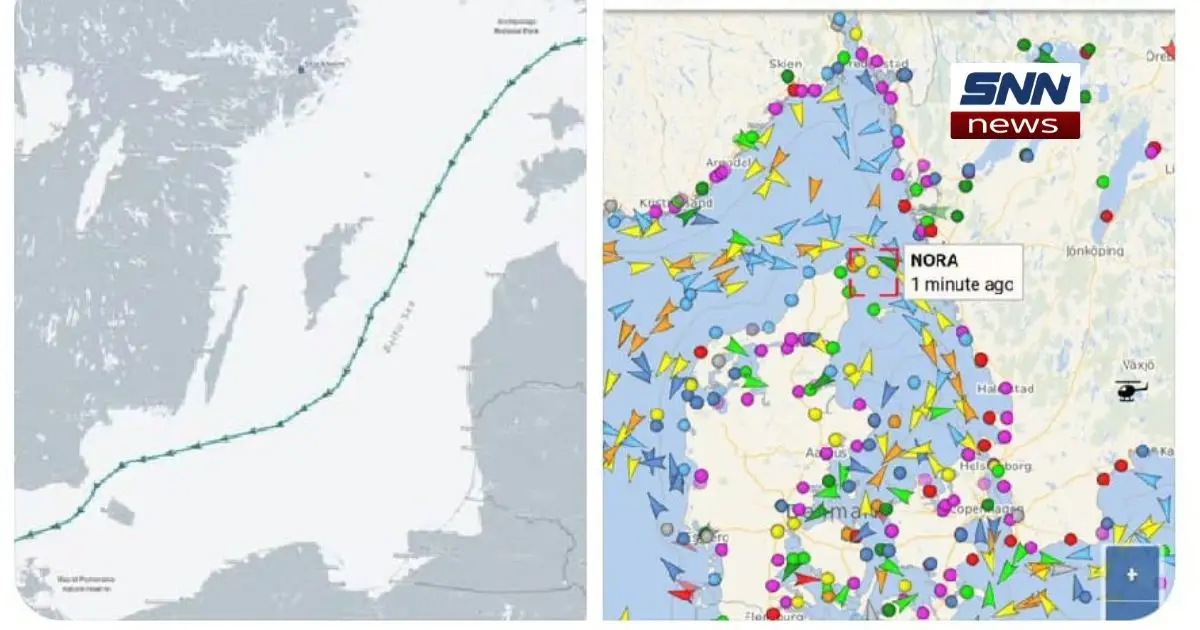
Tracking data reviewed by maritime monitoring services shows that Nora followed an unusual sailing pattern earlier this year. The ship repeatedly sailed north of Skagen, a major maritime junction where the North Sea and Baltic Sea meet, before continuing into Russian waters near St. Petersburg.
Between January 13 and January 16, the vessel systematically turned off its Automatic Identification System (AIS), effectively disappearing from public tracking platforms.
Disabling AIS is legal in limited circumstances for safety reasons, but repeated shutdowns in sensitive regions are widely regarded as a warning sign by maritime authorities.
After reappearing on tracking systems, Nora sailed back through the Baltic Sea and entered international waters between Denmark and Norway, where it remained largely stationary on January 22.
Monitoring and Inspection by Danish Forces
During its time near Danish waters, the vessel was briefly inspected by the Danish naval patrol ship P520 Diana. In addition, Danish naval drones were deployed to monitor the surrounding area, reflecting the seriousness with which authorities viewed the situation.
The ship later anchored in the Kattegat, approximately 28 kilometers east of Aalbæk, where it was formally detained pending further investigation.
Growing Focus on Maritime Security
The detention of Nora comes amid heightened European and transatlantic focus on maritime security, particularly in the Baltic and North Sea regions. Authorities are increasingly concerned about:
- Sanctions evasion through opaque shipping networks
- Risks to maritime safety from poorly maintained vessels
- Environmental hazards posed by unregulated operations
- Strategic shipping routes being used for covert activity
- Ship Nora
Shadow fleet operations have been linked in multiple reports to sanctioned oil transport and other restricted trade, prompting closer cooperation between European and U.S. authorities.
What Happens Next
The Danish Maritime Authority has emphasized that the case remains administrative at this stage. The vessel’s owners must provide valid and verifiable documentation proving lawful registration with its claimed flag state.
Until that process is complete, Nora will remain detained. Danish officials have not indicated a timeline for the review, noting that international coordination may be required.
Broader Implications
The Nora case highlights the growing challenge facing maritime regulators as global shipping becomes more complex and politically sensitive.
With increased scrutiny on shipping linked to sanctioned states, vessels operating outside standard transparency norms are likely to face stronger enforcement across European waters.
For Denmark and its neighbors, the incident underscores the strategic importance of monitoring key sea lanes and ensuring that international maritime rules are upheld consistently, regardless of a vessel’s origin or declared flag.
Read more about Ship Nora and growing maritime security and sanctions enforcement challenges in Nordic waters.
About The Author