
By Hammad Kahlun
Scandinavian news Finland
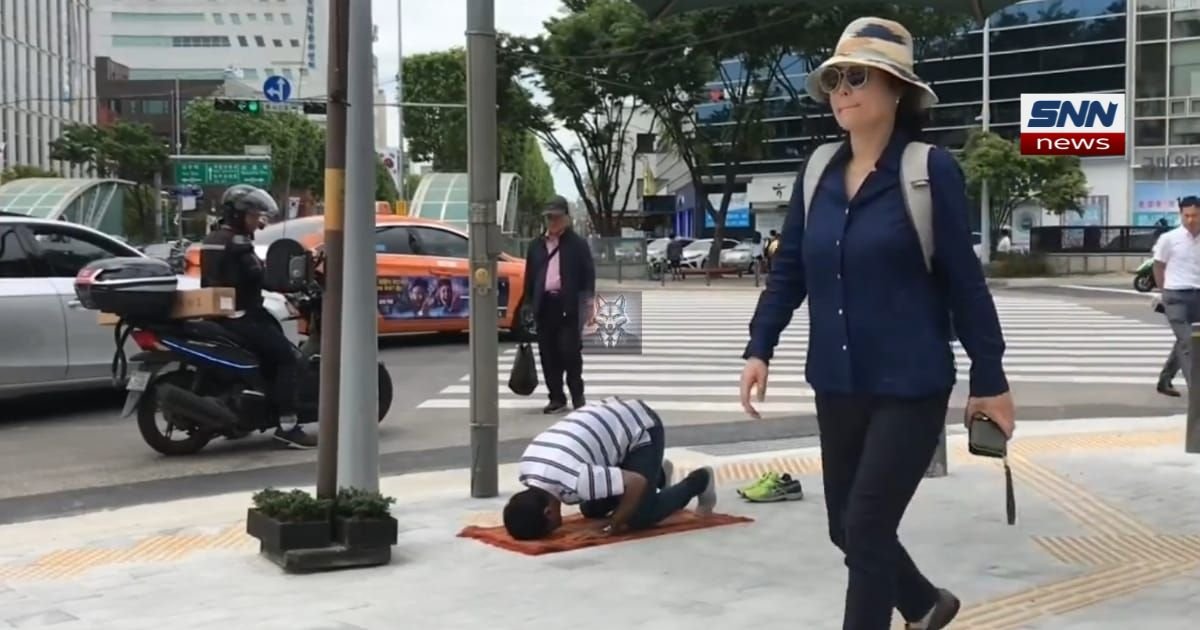
South Korea Muslim prayer has become a subject of renewed online discussion, but claims about individual Muslims deliberately praying in public to provoke Koreans or promote Islam’s superiority could not be independently verified from reliable sources reviewed for this article.
Available evidence does, however, show that South Korea has experienced several public disputes involving South Korea Muslim Prayer, mosque construction and perceptions of Islam.
These incidents have included opposition from local groups as well as concerns raised by Muslim communities about discrimination and religious freedom.
South Korea Muslim Prayer Claims Remain
The original claim reviewed by Scandinavian News Agency alleges that a Pakistani Muslim deliberately prays in public places so that Koreans will notice, ask questions and become exposed to Islamic teachings.
No reliable source found in the review independently establishes that this individual has such an intention. The claim should therefore be treated as an allegation rather than a confirmed description of the person’s motives.
The same caution applies to broader claims that Muslims deliberately create religious displays in public and then use accusations of Islamophobia whenever people object. There is no evidence in the reviewed sources supporting such a blanket characterization of Muslims in South Korea.
Earlier Mosque Disputes in South Korea
South Korea has nevertheless witnessed documented tensions surrounding Islam. One of the most prominent cases involved the construction of a mosque near Kyungpook National University in Daegu.
The dispute involved residents who raised concerns including noise, food smells and traffic. Muslim students and rights advocates, meanwhile, argued that opposition had developed into anti-Muslim hostility. South Korea’s Supreme Court ruled in 2022 that an administrative order stopping the mosque’s construction was illegal, according to reporting by Al Jazeera.
Academic research has also examined the Daegu dispute as part of wider debates over Islamophobia and religious freedom in South Korea. A 2023 article in the Journal of Human Rights Studies described the conflict as involving both neighbourhood concerns and broader anti-Islam sentiment.
Key Facts
- Claims about a specific Pakistani Muslim deliberately praying to provoke South Korea Muslim Prayer remain unverified.
- South Korea has documented disputes involving mosque construction and Muslim religious practices.
- The Daegu mosque dispute reached South Korea’s Supreme Court, which ruled against an administrative order halting construction.
- Academic research has linked some South Korean public debates about Islam to wider issues involving immigration, nationalism and religious freedom.
- Individual incidents should not automatically be generalized to South Korea’s entire Muslim population.
- South Korea Muslim Prayer
FAQs:
What Evidence Supports the Pakistani Muslim’s Motive?
No. The reviewed reliable sources do not independently establish that the person was deliberately praying publicly to provoke Koreans or promote Islam’s superiority.
Have Muslim-Related Disputes Occurred in South Korea Muslim Prayer?
Yes. The Daegu mosque dispute is a well-documented example involving Muslim students, local residents, construction and religious-freedom concerns.
Does public Muslim prayer prove Islamophobia?
No. Public prayer alone does not establish either Islamophobia or an intention to provoke others. The circumstances and evidence surrounding each incident need to be examined separately.
What happened in Daegu?
A mosque project near Kyungpook National University faced sustained local opposition. The Supreme Court later ruled that an administrative order stopping construction was illegal.
Is Islamophobia documented in South Korea?
Academic research has documented anti-Islamic rhetoric and conflicts surrounding Muslims and mosque construction, although individual disputes can also involve local concerns such as noise, traffic and food smells.
South Korea Muslim Prayer and Public Space
Public South Korea Muslim Prayer itself is not evidence that a person intends to provoke others or demonstrate religious superiority. Muslims, like members of other religions, may pray outside dedicated religious buildings when travelling, working or attending public events.
South Korea has previously provided prayer facilities for Muslim visitors. However, plans for mobile prayer rooms during the 2018 PyeongChang Winter Olympics were cancelled following opposition from an anti-Islam civic group, according to contemporary reporting.
More recent academic discussion suggests that debates surrounding Islam in South Korea Muslim Prayer remain connected to questions of immigration, multiculturalism, mosque construction and national identity.
A 2025 study by Kyungpook National University examined the role of the Protestant right in the spread of anti-Islamic rhetoric.
South Korea Muslim prayer practices and public religious activities have sparked wider discussions about religious freedom and social tensions.
About The Author