
By Hammad Kahlun
Scandinavian news Finland
What Happened, Where and Why It Matters
Pakistan’s Defence Minister Khawaja Asif has drawn international attention after making strongly worded remarks about Israel during a recent public statement that has been widely circulated across media and social platforms.
The comments, which addressed the ongoing conflicts in Gaza and broader regional tensions involving Lebanon and Iran, have triggered debate about diplomatic language, foreign policy positioning, and political rhetoric in South Asia.
The remarks come at a time when the Middle East remains highly volatile due to the continuing war in Gaza and rising cross-border tensions involving multiple regional actors.
Khawaja Asif statements have been interpreted by observers as one of the strongest political criticisms of Israel made by a senior Pakistani official in recent months.
Background: Rising Middle East Conflict and Global Reactions
The Israel-Gaza war, which escalated following the October 2023 conflict outbreak, has resulted in widespread destruction, civilian casualties, and a growing humanitarian crisis.
The conflict has also expanded diplomatic tensions across the Middle East, drawing reactions from governments in Asia, Europe, and the Muslim world.
Pakistan, which does not maintain diplomatic relations with Israel, has consistently expressed political and humanitarian support for Palestinians.
Pakistani leadership has repeatedly called for an immediate ceasefire, humanitarian access to Gaza, and renewed international mediation efforts.
Against this backdrop, Khawaja Asif’s comments reflect ongoing anger within parts of Pakistan’s political discourse regarding civilian casualties reported in Gaza and other regional flashpoints, including Lebanon and Iran-related tensions.
Khawaja Asif’s Statement: Strong Criticism of Israel
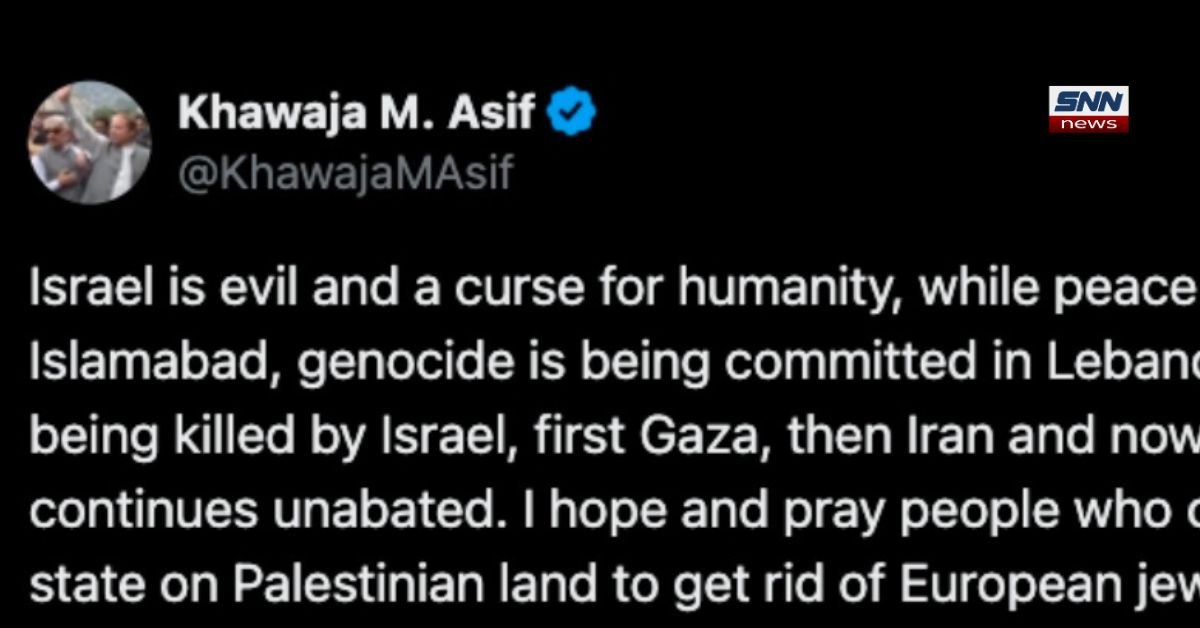
In his remarks, Defence Minister Khawaja Asif criticized Israel in unusually direct and emotionally charged language.
He accused Israel of being responsible for the killing of civilians in multiple regional conflicts and expressed strong condemnation of its military actions.
According to the statement attributed to him, Asif described Israel in highly critical terms and alleged that it has been involved in the killing of “innocent civilians” in Gaza and other affected regions.
He further expressed intense anger over the humanitarian situation, stating that those responsible for the creation and continuation of the conflict should face severe consequences.
In one widely circulated portion of his remarks, he used deeply emotional and religiously framed language expressing condemnation of the state of Israel and its leadership.
While the statement has not been independently verified in full transcript form by international media outlets at the time of reporting, multiple clips and excerpts circulating online show the minister speaking in a highly critical tone.
Key Points From the Statement
The remarks attributed to Khawaja Asif include several core themes:
- Firm criticism of Israel’s military actions in Gaza
- Allegations of civilian casualties in Gaza, Lebanon, and Iran-related tensions
- Emotional and religiously charged criticism of the Israeli state
- Calls for accountability for those responsible for ongoing conflicts
- Expression of deep frustration over humanitarian suffering in conflict zones
- Khawaja Asif
These statements have quickly spread across regional media outlets and social media platforms, generating both support and criticism depending on political perspectives.
Diplomatic and Political Implications
Foreign policy analysts suggest that such strong public statements from a senior defence official can carry diplomatic weight, especially in a region where tensions are already high.
Pakistan’s official stance has traditionally supported Palestinian statehood and criticized Israeli military actions, but the tone of political rhetoric can influence international perception.
Experts note several potential implications:
Impact on Pakistan’s Diplomatic Position
- Pakistan maintains no formal diplomatic ties with Israel
- Statements like these reinforce Pakistan’s traditional pro-Palestinian stance
- However, highly charged language may complicate indirect diplomatic channels
- Khawaja Asif
Regional Sensitivities
- The Middle East conflict is deeply sensitive for global diplomacy
- Public remarks by state officials are often closely monitored internationally
- Strong rhetoric can sometimes trigger diplomatic pushback or clarification requests
- Khawaja Asif
Media and Global Attention
The comments have been picked up by regional media networks, particularly in South Asia and the Middle East, highlighting how political statements in one country can quickly become part of global news narratives.
Pakistan’s Broader Foreign Policy Context
Pakistan’s foreign policy regarding the Middle East has historically been shaped by several key principles, including support for Muslim-majority nations, advocacy for Palestinian statehood, and alignment with international humanitarian law frameworks.
Over the years, successive Pakistani governments have:
- Supported United Nations resolutions calling for a two-state solution
- Condemned civilian casualties in conflict zones
- Called for ceasefires during escalations in Gaza
- Avoided formal diplomatic recognition of Israel
- Khawaja Asif
Within this framework, Defence Minister Khawaja Asif’s remarks are consistent with Pakistan’s general political stance, although the intensity of language stands out compared to standard official diplomatic communications.
Social Media Reaction and Public Discourse
Following the circulation of the remarks, social media platforms saw a wide range of reactions. Supporters of the statement viewed it as a strong expression of solidarity with Palestinians and a reflection of public sentiment in Pakistan regarding the Gaza conflict.
On the other hand, critics argued that such emotionally charged language from a senior government official could be diplomatically counterproductive, especially in an already fragile international environment.
The debate highlights a broader issue in modern politics: the growing influence of social media amplification, where official remarks can rapidly gain global visibility and spark international discussion within hours.
Humanitarian Context: Civilian Impact of Ongoing Conflicts
At the center of the controversy remains the humanitarian situation in conflict zones. International organizations have repeatedly reported severe civilian suffering in Gaza, including shortages of food, medicine, and shelter due to prolonged hostilities.
Similarly, tensions involving Lebanon and Iran-linked regional dynamics have further complicated the geopolitical landscape, raising concerns about broader regional escalation.
Human rights groups continue to call for:
- Immediate ceasefire agreements
- Protection of civilian populations
- Unrestricted humanitarian aid access
- Renewed diplomatic negotiations
- Khawaja Asif
These issues form the broader context in which political statements like Khawaja Asif’s are being interpreted globally.
Conclusion: A Statement Reflecting Regional Tensions
Khawaja Asif’s remarks underline the deep emotional and political sensitivities surrounding the ongoing Middle East conflict.
While consistent with Pakistan’s long-standing diplomatic position on Palestine, the strong tone of the statement has added to international debate over political rhetoric and responsible communication during times of war.
As global diplomatic efforts continue to seek stability in the region, such statements highlight both the intensity of public sentiment and the challenges faced by policymakers navigating complex international conflicts.
Read more related coverage on Middle East conflict, Gaza war updates, and Pakistan foreign policy analysis.
About The Author