
By Hammad Kahlun
Scandinavian News Finland
EU Records First Decline in Ukrainian Temporary Protection Status Holders
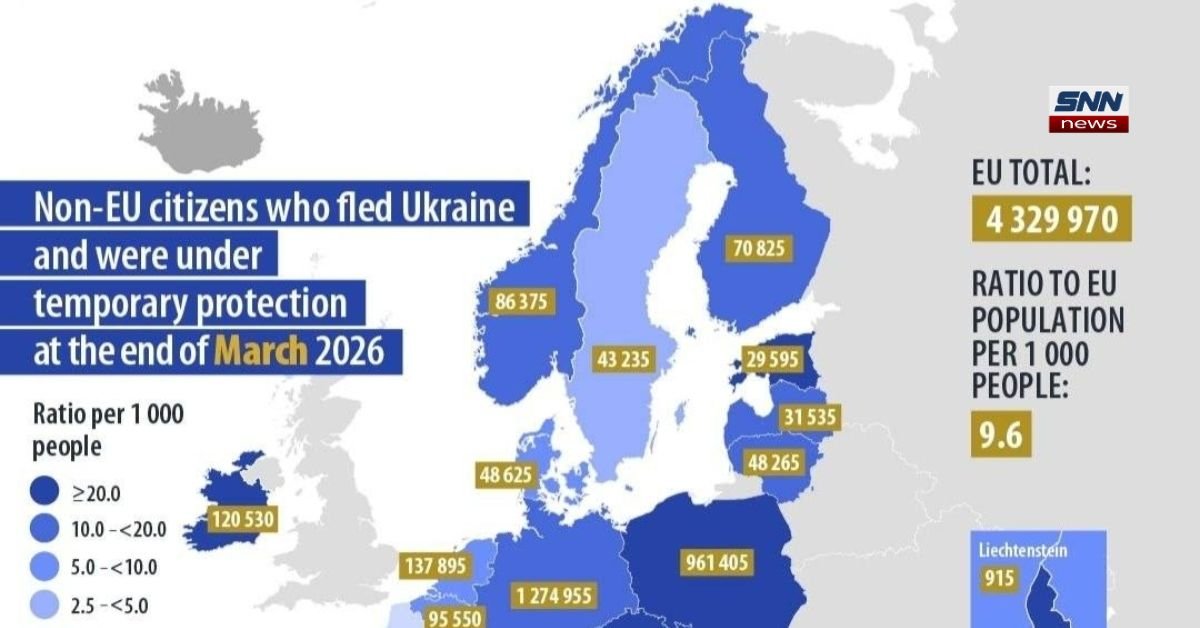
The number of Ukrainian refugees holding temporary protection status across European Union member states has fallen by 1.6 percent, according to the latest figures released by Eurostat, the EU’s official statistical authority.
The decline marks a notable shift in a refugee situation that has defined European migration policy since Russia launched its full-scale invasion of Ukraine in February 2022.
While the drop may appear small in percentage terms, it represents tens of thousands of people and raises important questions about where displaced Ukrainians are going, and why.
Where the Largest Ukrainian Refugee Populations Remain
Despite the overall decline, millions of Ukrainians continue to live under temporary protection across Europe. The three countries hosting the largest numbers are:
- Germany 1.27 million Ukrainian refugees, the highest of any single EU member state
- Poland nearly 1 million, reflecting the country’s geographic proximity to Ukraine
- Czechia 379,800, making it one of the largest host nations relative to its own population size
- Refugee
These three countries alone account for the overwhelming majority of Ukrainian temporary protection holders currently registered within the EU.
Germany’s position at the top of the list reflects both its size and its comparatively generous social support system. Poland, which shares a long border with Ukraine, became the first major entry point for refugees fleeing the conflict in 2022 and has maintained one of the largest displaced populations ever since.
Global Picture: 5.76 Million Ukrainians Still Displaced Worldwide
The EU figures sit within a much larger global displacement crisis. According to the United Nations High Commissioner for Refugees (UNHCR), there are currently 5.76 million Ukrainian refugees worldwide.
Of that total, more than 5.2 million remain in Europe meaning the vast majority of displaced Ukrainians have stayed within the continent, largely within reach of their home country.
This geographic concentration reflects a pattern distinct from many other refugee crises. Ukrainian refugees have, on the whole, remained close to home — many maintaining the hope or intention of returning once security conditions allow.
What Is Temporary Protection Status?
Temporary protection status is a legal mechanism activated by the European Union to provide fast, collective protection to large numbers of displaced people without requiring individual asylum assessments.
It was triggered by the EU for the first time in its history in March 2022, specifically in response to the mass displacement caused by Russia’s invasion of Ukraine.
Under temporary protection, Ukrainian refugees across EU member states receive:
- The right to reside legally in the host country
- Access to employment and labour markets
- Access to education, healthcare, and social welfare
- Travel rights within the EU
The status has been extended multiple times since 2022 and currently remains in effect. Its continuation is reviewed regularly by EU institutions in light of conditions inside Ukraine.
Why Are Numbers Falling? Key Factors Explained
Voluntary Returns to Ukraine
A significant portion of the decline is attributed to Ukrainians choosing to return home particularly to regions considered relatively stable or away from active frontlines. UNHCR has documented a pattern of return movement, especially among men of working age and families with school-age children seeking continuity.
Resettlement to Non-EU Countries
Some Ukrainian refugees have relocated beyond Europe entirely, taking up resettlement offers in countries including Canada, the United States, and the United Kingdom none of which are EU member states and therefore fall outside Eurostat’s counting framework.
Registration and Administrative Changes
A portion of the statistical decline may also reflect administrative factors refugees whose temporary protection registrations have lapsed, expired, or been transferred between systems rather than individuals who have physically left Europe.
The Broader Context: Three Years of Europe’s Largest Refugee Crisis
The displacement of Ukrainians following February 2022 represents the fastest and largest refugee movement in Europe since the Second World War.
At its peak in 2022 and early 2023, the UNHCR estimated that more than eight million Ukrainians had fled abroad, with millions more internally displaced within Ukraine itself.
The gradual stabilisation of these numbers and now the first recorded decline in EU temporary protection holders — reflects three years of complex movement: some returning, some settling permanently, some moving between countries, and millions still waiting.
For host countries, the practical and financial implications have been substantial. Germany, Poland, and Czechia have collectively invested billions in housing, education, healthcare, and social integration for their Ukrainian populations. The question of long-term integration versus return readiness remains one of the defining policy challenges facing European governments in 2026.
What This Means Going Forward
The 1.6 percent decline in EU temporary protection numbers is a data point, not a resolution. The conflict in Ukraine continues. The conditions that created this refugee crisis have not ended.
For the millions of Ukrainians still living abroad in German cities, Polish towns, Czech communities, and across the broader European continent the question of when, whether, and how to go home remains deeply personal and deeply uncertain.
What the Eurostat figures confirm is that the situation is moving. Whether that movement represents progress, or simply the passage of time in the face of an unresolved war, remains to be seen.
Explore how European nations are responding to the growing Ukrainian refugee crisis and what temporary protection means for millions still displaced.
About The Author