
German Gen Z protests —
By Hammad Kahlun
SNN News Finland
Germany’s youth-led protests over living costs, education funding and military spending ended in violence in several cities, with shops looted in Frankfurt and more than one hundred police officers injured, according to the interior ministry of the state of Hesse and city police. Police arrested 54 people in Frankfurt alone.
What the authorities say happened
Roman Poseck, interior minister of Hesse, told a press conference on Sunday that rioters in Frankfurt Germany’s financial centre damaged 17 shops and stores, five of which were looted. He said police deployed up to 1,300 officers at the peak of the operation, and that more than 100 were injured in clashes, including one officer who lost teeth after being hit in the face with a stone.
Poseck said around 100 clearly identified left-wing extremists had infiltrated the demonstration, that the way the day ended was “shameful”, and that further demonstration bans were being considered. “I am shocked by what I have seen, and there is no point in sugar-coating it,” he said. Federal interior minister Alexander Dobrindt called for tough penalties for those responsible.
Frankfurt police said on social media that “violent riots” had broken out in the city centre, that shop windows were smashed, that Molotov cocktails were thrown at emergency services, and that fire and rescue crews were attacked. Police said a gun shop’s windows were smashed and that two weapons were seized after a suspect was arrested. In their summary of the night, police reported 87 criminal complaints, 1,225 orders barring people from the area, and 366 people checked.
There were also clashes in Cologne, where police said officers were pelted with bottles and bicycles near the cathedral before water cannon were used, in Berlin, where police said demonstrators threw fireworks, bottles and stones at officers and emergency crews, and in Hamburg.
A mostly peaceful day, then a violent night
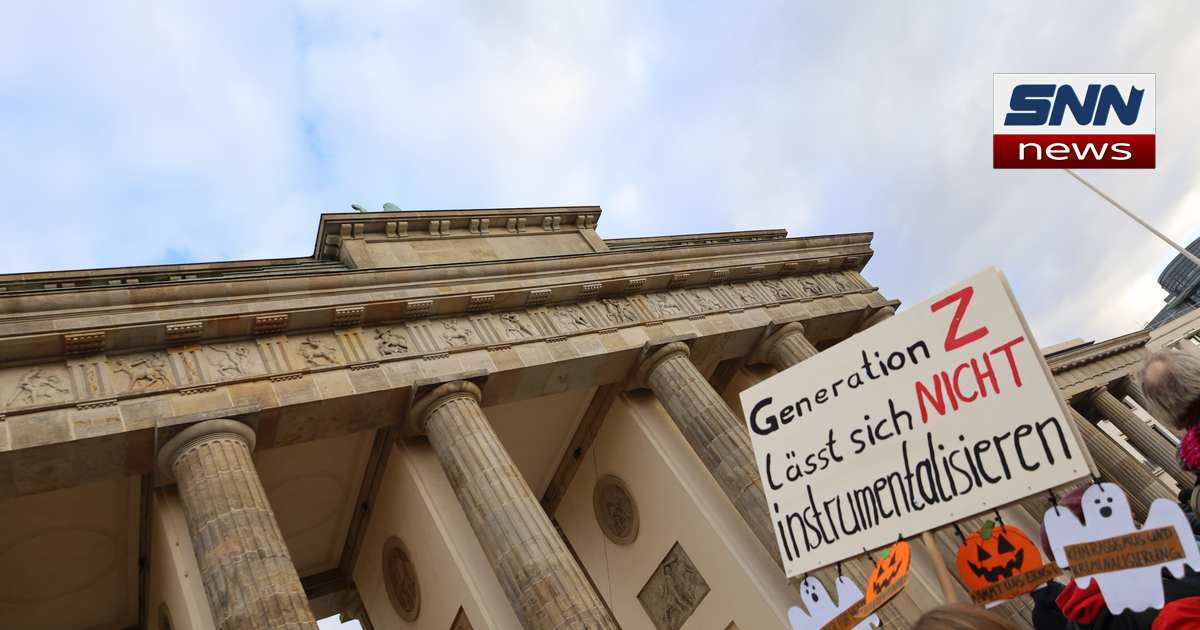
Tens of thousands of people had taken part in Saturday’s demonstrations organised by the youth campaign group Gen Z regelt “Gen Z has got this” which staged rallies in more than thirty cities. Organisers put the national turnout at around 120,000 people. Police said the rallies themselves had been “very peaceful”, and the organisers distanced themselves from the violence after dark, saying the vandalism did not represent the movement that had filled city squares during the day.
In Berlin, police counted several thousand demonstrators in the capital. Elsewhere the day passed largely without incident until the evening, when masked groups broke away in Frankfurt and other city centres. Shopkeepers had boarded up windows before the weekend, and the damage was concentrated in central shopping streets.
What the protests are about
The German protests are the local expression of a wider European wave. The campaign’s demands focus on education spending, housing and living costs and public services, and it opposes the sharp increase in military spending and a new voluntary service model that many young people fear is a step towards conscription.
Similar movements have mobilised in France, Italy, Spain, Portugal and Albania in recent weeks, in demonstrations that have mixed mass peaceful rallies with smaller outbreaks of violence among them the student protests that filled Tirana, part of the same European wave of anger over costs and public services that SNN Finland has followed through the political arguments inside the European Union. In France, more than 320,000 people demonstrated and hundreds were arrested in a third day of action over schools and purchasing power. In Portugal, police clashed with housing protesters and arrested thirteen people in a separate demonstration.
German gen z protests: key facts
Key facts
- German Gen Z protests: what is confirmed so far, and what remains open
- Organisers: Gen Z regelt, a youth campaign group demanding education funding, lower living costs and opposition to higher military spending
- Scale: More than thirty cities; organisers said around 120,000 people took part nationwide
- Frankfurt damage: 17 shops and stores damaged, five looted, according to Hesse interior minister Roman Poseck
- Police: Up to 1,300 officers deployed in Frankfurt; more than 100 injured, one seriously; 54 arrests of people aged between 13 and 29
- Police records: 87 criminal complaints, 1,225 bans from the area, 366 people checked
- Context: Part of a European protest wave, with more than 320,000 demonstrating in France and arrests in Portugal
FAQs:
Who is behind the protests?
The campaign group Gen Z regelt, which organised rallies in more than thirty German cities and has distanced itself from the violence after nightfall.
How serious was the violence?
Confined to city centres in a handful of cities, but serious: shops were looted in Frankfurt, a gun shop was attacked and two weapons were seized, more than 100 officers were injured and 54 people were arrested in the city.
What do the protesters want?
Better funding for education, action on the cost of living and housing, and no further increases in military spending, along with opposition to a new voluntary service model they fear leads to conscription.
Is this only happening in Germany?
No. Similar youth-led movements have held mass demonstrations in France, Italy, Spain, Portugal and Albania in recent weeks, and the demands are broadly the same.
Why it matters
The unrest puts a generation raised in cheaper money and now facing higher rents, higher food prices and a labour market being reshaped by artificial intelligence at the centre of European politics. It also sets up a fight over priorities: governments in Berlin and Paris have committed to large increases in defence budgets while holding down other spending, and the protesters argue that schools, universities and housing are being squeezed to pay for rearmament.
For Germany’s government, the violence is also a test of policing. The figures released on Sunday show how quickly a mass, mostly peaceful mobilisation can be overtaken by a few hundred people prepared to attack officers and loot shops and how that violence then changes the political argument about the movement as a whole.
Violent clashes erupted during Gen Z-led protests in Germany, with several shops reportedly looted as authorities responded to the unrest.
Frequently asked questions
Who is behind the protests?
The campaign group Gen Z regelt, which organised rallies in more than thirty German cities and has distanced itself from the violence after nightfall.
How serious was the violence?
Confined to city centres in a handful of cities, but serious: shops were looted in Frankfurt, a gun shop was attacked and two weapons were seized, more than 100 officers were injured and 54 people were arrested in the city.
What do the protesters want?
Better funding for education, action on the cost of living and housing, and no further increases in military spending, along with opposition to a new voluntary service model they fear leads to conscription.
Is this only happening in Germany?
No. Similar youth-led movements have held mass demonstrations in France, Italy, Spain, Portugal and Albania in recent weeks, and the demands are broadly the same.
About The Author