
By Muhammad Zia Mohiuddin
SNN News, Rawalpindi
The Middle East is witnessing an important geopolitical moment. From Washington’s changing political calculations to Tehran’s diplomatic engagement, the region appears to be entering a new phase of strategic realignment.
Talks in Tehran
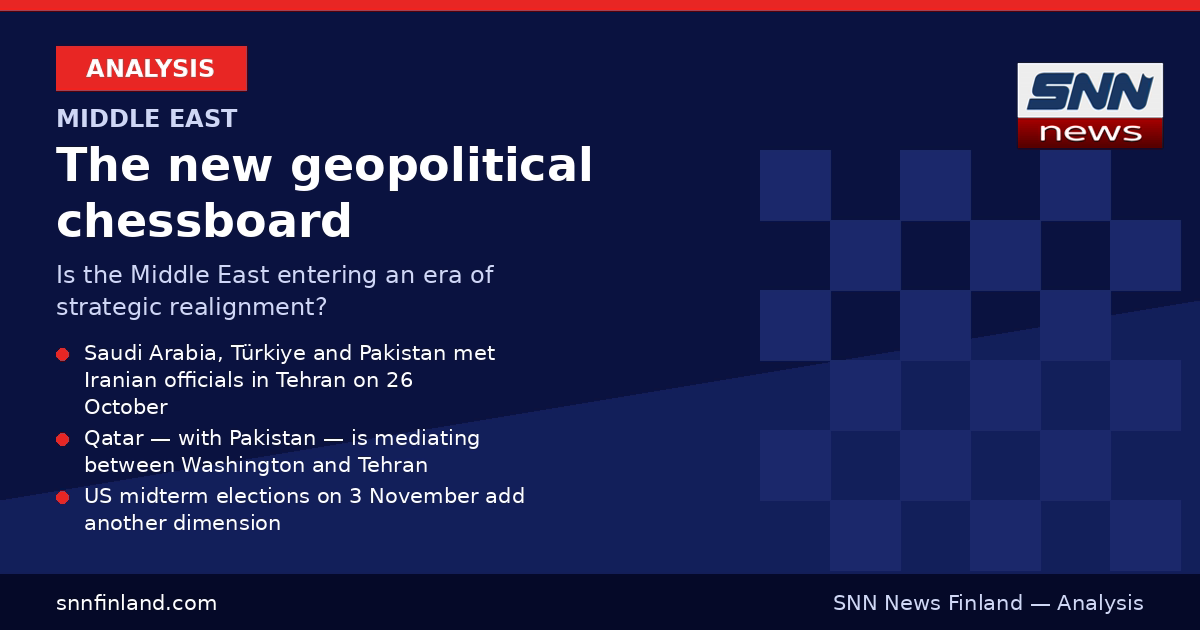
On 26 October, Saudi Arabia, Turkiye and Pakistan held high-level discussions with Iranian officials in Tehran aimed at preventing further escalation. Iran’s Supreme National Security Council hosted the meeting, the first of its kind between members of the Mecca Joint Defence Agreement and Tehran.
Defence and security officials took part, and Iran’s president received the delegations. The format matters: three states that share a defence framework sat down with Iran rather than around it.
Qatar’s mediation
Qatar is also playing a diplomatic role, attempting to reduce tensions between Washington and Tehran, work it has carried out alongside Pakistan. Qatari mediators have carried proposals between the two capitals, and American officials have publicly credited regional mediation with helping to create an opening for de-escalation.
This is particularly significant because countries with different security interests are increasingly recognising the importance of regional dialogue.
Gulf coordination
Meanwhile, Saudi Arabia and Kuwait have strengthened their diplomatic and defence coordination. Their recent discussions reflect a shared concern about regional security and the growing threat of instability, with attacks on Saudi territory underlining the pressure on Gulf air defences.
America’s midterms
America’s 3 November 2026 midterm elections add another dimension. These are not presidential elections, but their results could influence President Donald Trump’s domestic political position and future foreign-policy calculations, particularly towards Iran.
For the region, the question is whether Washington’s approach hardens or softens afterwards, and whether diplomacy keeps its current momentum.
Cooperation is not unity
However, the emerging picture is not simply about friendship or a united Islamic political block. Saudi Arabia seeks regional security, Iran wants to protect its strategic position, Turkiye wants greater geopolitical influence, Pakistan is pursuing diplomatic relevance, and Qatar continues to use mediation as an instrument of foreign policy.
Each is pursuing its own interest, and several of those interests compete.
Key facts
- 26 October: Iran, Saudi Arabia, Turkiye and Pakistan held high-level talks in Tehran, hosted by Iran’s Supreme National Security Council.
- Mediation: Qatar, working with Pakistan, is mediating between Washington and Tehran.
- Gulf: Saudi Arabia and Kuwait have stepped up diplomatic and defence coordination.
- 3 November: US midterm elections could shape Washington’s Iran policy.
- The catch: shared talks do not mean shared interests – each state is pursuing its own agenda.
- Geopolitical
FAQs:
What happened in Tehran on 26 October?
Saudi Arabia, Turkiye and Pakistan held high-level discussions with Iranian officials, hosted by Iran’s Supreme National Security Council, aimed at preventing further escalation.
Who is mediating between the US and Iran?
Qatar, working alongside Pakistan, has been carrying proposals between Washington and Tehran.
Why do the US midterms matter to the Middle East?
They could shift President Trump’s domestic position and, with it, his foreign-policy calculations towards Iran.
Is the region forming a united bloc?
No. The participants have different and often competing interests; dialogue is not the same as political unity.
What would success look like?
Measured by ordinary people’s lives, not by another regional power struggle.
Where are these relations heading?
The region may be moving from traditional rivalries towards pragmatic diplomacy, but cooperation does not necessarily mean political unity. National interests, military calculations and external powers will continue to shape these relationships.
SNN News Finland has covered the confrontation behind these talks, including the cost of the US campaign against Iran and strikes on Saudi energy infrastructure, as well as the Mecca defence agreement that now includes the states at the Tehran table.
Ultimately, geopolitics should not be measured only through military agreements, diplomatic meetings or changes in government. Its real success should be measured through the lives of ordinary people.
For families facing displacement, young people struggling with unemployment and civilians living under the shadow of conflict, another regional power struggle is not an achievement. The Middle East does not simply need a new balance of power; it needs a new balance of peace.
The evolving geopolitical landscape in the Middle East is reshaping regional alliances, strategic interests and the balance of power among global players.
About The Author