
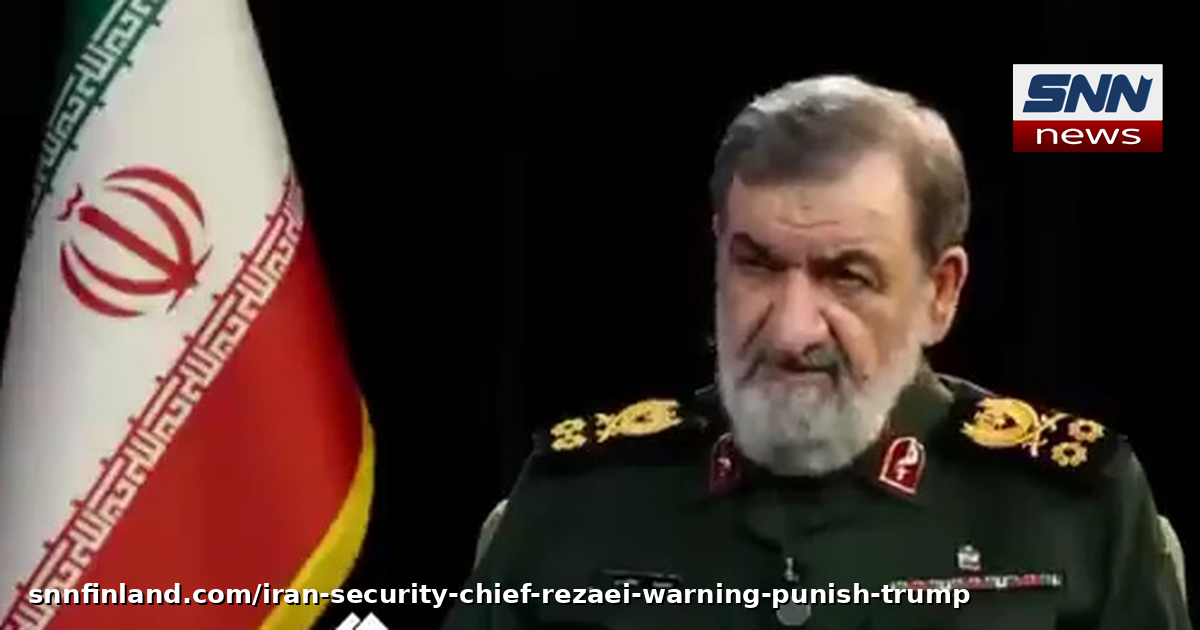
Mohsen Rezaei —
By Riffat Kausar
SNN News Finland
Iran’s top Security Chie official has framed the standoff with Washington as a test of deterrence itself, saying that if the United States is not made to pay a price, other governments will conclude that attacking Iran carries no consequences.
Mohsen Rezaei, secretary of Iran’s Supreme National Security Council, made the remarks in an interview with Iranian state television on Saturday, 31 October 2026.
In the same appearance he said Washington’s tone had changed, confirmed he had read a letter from US Vice President JD Vance but had not yet replied, and repeated that Tehran would not negotiate or reopen the Strait of Hormuz until seven conditions are met.
What Rezaei said about punishment and deterrence
Rezaei’s argument is that the value of Iran’s deterrent rests on the price an adversary expects to pay. In his words: “If we do not punish Trump and the United States, other countries will conclude tomorrow that attacking Iran carries no consequences.”
The line sits inside a longer set of remarks in which he said Iran would respond severely to any new attack, and that a war should end in a way that leaves no government willing to attack Iran again.
Accounts of the interview were carried by Iranian state media; the exchange took place in Persian, so the English wording above is a translation. SNN Finland has not independently verified the exact phrasing beyond those published accounts.
The seven conditions blocking talks
Rezaei repeated that Iran will not return to negotiations, or reopen the Strait of Hormuz, until the United States meets conditions Tehran set through intermediaries.
Those demands include an end to the war on all fronts, the release of frozen Iranian assets, an end to the naval blockade of Iranian ports, an end to attacks on Iranian territory, and a demand that other countries stay out of what Tehran calls the US economic war.
He said diplomatic exchanges had been under way for more than a month. On the Vance letter, sent through Qatari mediators at President Donald Trump’s direction, Rezaei said he had read it, had not answered it, and described a change in Washington’s approach as “a good sign” while insisting the conditions still stand.
Mohsen rezaei: key facts
Key facts
- Mohsen Rezaei: what is confirmed so far, and what remains open
- Mohsen Rezaei is secretary of Iran’s Supreme National Security Council, a major general and a former commander of the Revolutionary Guard.
- He said that if the United States is not punished, other states will conclude that attacking Iran carries no consequences.
- Iran says it will not negotiate or reopen the Strait of Hormuz until seven conditions are met, including releasing frozen assets and lifting the naval blockade.
- Rezaei confirmed he read a letter from US Vice President JD Vance but has not replied, and called Washington’s changed tone “a good sign”.
- Iran says it is debating whether to keep its ban on nuclear weapons; no decision has been announced.
- Security Chief
FAQs:
Did Rezaei threaten a direct attack on the United States?
He warned of a severe response to any new attack and said the price of aggression must be high. He did not announce a specific operation, and Iran has not claimed responsibility for any new strike.
Is the Strait of Hormuz still closed?
Iran has said it will not reopen the strait until its conditions are met. Rezaei linked the closure directly to those demands in the same interview.
Has the United States responded to the remarks?
No direct response to this interview had been published when this report was prepared.
What has changed in Washington’s approach?
According to Rezaei, the tone has shifted and a letter proposing comprehensive direct negotiations was sent through Qatari mediators. Iran has not formally replied to it.
Could Iran leave the nuclear Non-Proliferation Treaty?
Rezaei said the question of maintaining the ban on nuclear weapons is being debated inside Iran, with no decision taken. That is a debate, not a policy change.
Military and nuclear context
The interview came after weeks of US strikes on Iran and a US naval blockade of Iranian ports, with Trump publicly threatening to strike power plants and bridges unless Tehran negotiates.
Iran’s supreme leader, Mojtaba Khamenei, has ordered that any response to a new attack not be restricted by geography, according to accounts of the instruction, and Iranian officials have said the military’s target list is being updated.
Rezaei has also said that US commercial and digital assets in the region data centres, artificial intelligence facilities and undersea cables, which he valued at more than two trillion dollars could become targets if Washington launches another round of attacks.
Separately, he said Iran is debating whether to maintain its ban on nuclear weapons, adding that no decision has been taken. That question is one of the reasons Washington’s allies are watching the file closely.
Qatar and Pakistan have been mediating, and a four-way meeting in Tehran on 26 October brought together Saudi, Turkish and Pakistani officials with Iranian counterparts to discuss regional security. Those channels have so far produced talks about talks rather than an agreement.
Iran’s security chief has warned that failing to hold US President Donald Trump accountable could make future military action against Iran appear cost-free, highlighting Tehran’s concerns over deterrence, regional security and the consequences of further escalation.
About The Author